September 28, 2026
From Building Classroom AI to Teaching It
Learn how Shariq Shah, CEO of Edvisor.ai, brings real-world AI expertise to GGU as instructor of AI 300, teaching students to build and deploy intelligent systems.
Golden Gate University’s Master of Business Administration (MBA) program is designed to equip students with the essential skills and knowledge needed to excel in today’s dynamic business landscape. With a strong emphasis on practical application and real-world scenarios, the MBA program prepares graduates for leadership roles and career advancement across various industries.
At GGU, our MBA is specifically designed for working professionals. With online, evening, and hybrid formats, you can immediately apply what you learn on the job — and move forward without putting your life on hold. Whether you’re interested in starting a new career path or qualifying for leadership roles within your organization, the MBA program offers a variety of unique concentrations, flexible courses, and personalized support to help guide you to the next step of your business career.
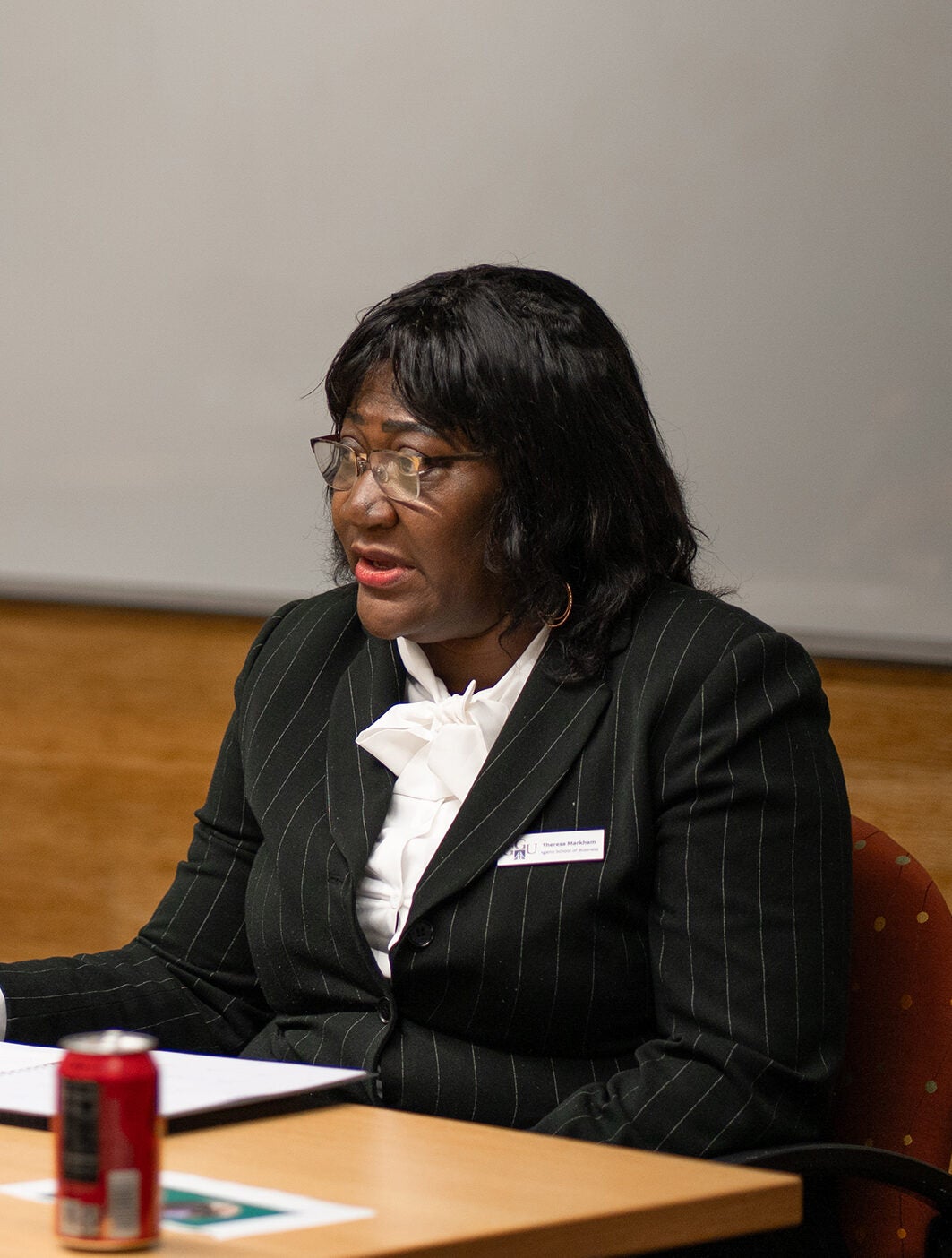
Recently, we sat down with Theresa Markham, Associate Director of the MBA program, to discuss the unique aspects of the program, how it prepares students for complex challenges and opportunities in the current business world, and the supportive community at GGU.
 I’m originally from Ghana, West Africa. I earned my undergraduate degree from the University of Ghana, then came to San Francisco to pursue my master’s at San Francisco State University. After that, I continued my education at Golden Gate University, where I earned a second master’s degree in human resources.
I’m currently the Associate Director for the Master of Business Administration program, but I’ve actually been teaching at Golden Gate University for the past eight years. I’ve taught undergraduate courses, including capstone courses in management and leadership strategy. I enjoyed it so much that I decided to continue into the MBA program, where I’ve been teaching Leadership Skills, Management, Business Planning, and Teamwork in Organizations.
The world of business is incredibly complex, uncertain, and ambiguous, as many of us know. What makes Golden Gate University unique is, first and foremost, our small class sizes. Our smaller class sizes and flexible course modalities make GGU a smart investment for working professionals who want both quality and affordability — without sacrificing career outcomes.
Other unique aspects are the diverse nature of our classes and the qualifications and backgrounds of our professors. Our professors are experienced professionals who are actively working in San Francisco and Silicon Valley. We specifically choose faculty with significant work experience so they can share their real-world insights directly.
Golden Gate University is also located right in the heart of San Francisco. We’re surrounded by numerous major companies, like Salesforce, which naturally inspires our students to seek internship opportunities. We’re also very close to Silicon Valley, which is home to so many startup businesses.
Finally, an incredibly unique thing I’ve observed is our supportive alumni network of about 70,000 alumni worldwide. While not every single one is actively involved, the majority are highly interested in mentoring our students directly or even coming into the classroom to share their personal journeys and experiences, which profoundly impacts our students. This is something truly special that I haven’t seen anywhere else. In fact, our alumni often help our students find jobs and internships, which is an enormous benefit.
At GGU, we emphasize the importance of leading with ethical and social responsibility. GGU’s MBA program prepares students to be conscious of their ethical and social responsibilities in today’s business world and teaches them to become trustworthy leaders who lead by example. There are many organizational leaders who have failed by not leading in an ethically responsible way, and that’s why we stress the value of these skills and traits.
In our curriculum, we strategically use real-case articles from Harvard Business School. We select cases that reflect real-world scenarios and integrate them into our students’ learning experiences. What this means is, we empower students to act as protagonists, essentially stepping into the shoes of directors within these cases. We ask them, “What would you do if you found yourself in this situation?” This approach helps students develop critical thinking skills, analyze complex cases, and formulate solutions. After all, solving problems is at the core of the real business world, isn’t it? This strategy genuinely prepares students to think and act like a director or manager.
Another unique aspect at GGU is that our faculty deliberately groups students into small teams, encouraging rich interaction. You won’t just be learning from professors — you’ll be learning alongside peers with deep industry experience, including veterans, career switchers, and managers ready to lead.
In my own classes, I use a strategy that brings together local students with international students, and international students with veterans. This creates a remarkably rich experience for everyone, as they’re all coming from diverse cultures and backgrounds. It’s wonderful to have faculty who think about enriching student knowledge in this way.
We also strongly emphasize presentations. Business leaders are expected to present and represent their organizations, for instance, to engage investors. If you can’t deliver effective presentations, then what kind of manager or leader are you? This is a key strategy many of our faculty employ: pushing students to give presentations in front of the class. And finally, we focus heavily on critical thinking and analyzing situations, which forms a significant part of how we evaluate our students.
As I mentioned earlier, there are many companies right here in the city that the university actively engages with. We reach out personally to organizations like Salesforce, JP Morgan Bank, Citibank, and numerous small startup companies to arrange opportunities for students to visit their sites and experience the work firsthand. This makes the business world feel much more real for them.
Another great advantage of being in the heart of San Francisco is our excellent proximity to transportation, which makes it incredibly convenient for students to travel from various locations to school, to internships, and then safely back home.
Many of my students actually keep in touch with me, expressing their gratitude for my role as their professor and for the impact I’ve had on their career paths. Our GGU alumni include CEOs, CFOs, and leaders at Fortune 500 companies like Bank of America and Kaiser Permanente — proof that our MBA program delivers real-world results.
I begin my classes by making students aware that they are not moving backward; they are advancing into managerial roles. Once a student grasps that they are climbing the ladder, that I am preparing them to be strong team leaders, they internalize that they are moving towards becoming decision-makers — CFOs, COOs, CEOs, directors, executive officers, or heads of departments. This is precisely where I see my MBA students heading in their careers. Some are already employed but are seeking opportunities to grow into leadership positions, and they reach out to thank me for helping them achieve their current success.
I’ve been working very closely with GGU’s Career Services team because, currently, they’re our primary resource for helping students. However, I’ve connected with a few organizations to explore how we can establish ongoing relationships for continuous student experiences. At present, we utilize the Student Services Career Center to find job opportunities. This allows students to have their resumes reviewed and critiqued, and also to prepare for mock interviews.
We also offer many webinars and resources related to career planning through that office, so students can certainly take advantage of those. And I am personally working on securing even more direct opportunities for internships and job listings.
The program is specifically designed with foundation courses like Management 202: Foundations of Business, which provides essential basic skills, along with Statistics, and Business 240: Data Analysis for Managers. That data analysis course is truly foundational because you need to understand how to use spreadsheets, grasp statistics, and perform regression analysis to effectively navigate the program.
Once you enter the program, we have a clear outline of core courses. They include LEAD 300: Management in Leadership, where we help students clearly distinguish what it means to be a leader versus a manager. There are several distinctions, and sometimes people get confused, thinking a manager should automatically be a leader. We help them recognize these differences, while also showing how you can combine those two roles. A leader, for instance, looks ahead, focusing on developing employees, assessing their skill sets, and thinking five years into the future. A manager, on the other hand, focuses on policies and procedures to ensure tasks are completed. These are the kinds of distinctions we help students understand.
We also focus a lot on teams: how do you work effectively in teams? We train our managers to see things from different perspectives. How does the human brain process and accept individuals who are different from each other? Why do they come together to work collaboratively? We emphasize teamwork. Then there’s our finance course, which teaches you how to manage your finances, and the marketing course, which focuses on how to market your products. These courses equip students with the skills to market effectively in a competitive, global business environment. The Operations 300 course covers how to acquire resources. When we talk about the imposition of tariffs in a competitive world, and how that affects the prices of your products, where do you source your resources from? It’s a strategic way of understanding the market. We groom students to understand things from a much broader perspective.
And then, at the very end of the program, there’s the capstone course, called Business Planning. After completing all the core courses and having chosen your concentration courses from areas like leadership or finance, based on your passion, you bring all these ideas together to develop a business plan. This is presented as a document that students create and then present to the class. Some of our students have actually gone on to develop these business plans into their own businesses and have even emailed me to see if they can recruit some of our current students as interns. Just last semester, a student who was in my class, reached out to me. He said, “Professor Markham, I just want to let you know I’ve opened my business,” and I asked, “Is it based on the course you talked about?” He said yes, and then he added, “And I want two interns to work with me!”
The learning environment is such that if you’re a quiet person, you’ll definitely learn to become more outgoing. You’ll need to be someone who actively engages, because we actually give points for participation. So, we expect students to share their experiences and even to interject politely when appropriate.
It’s a very friendly, cordial, and highly engaging environment for our students. This is crucial because it’s the only way you truly connect with the reality of how business is conducted in a real-world scenario. I think that’s incredibly important for people to feel comfortable and supported by their fellow students and professors, which helps them grow these essential skills.
We are actively developing the MBA Club, and we really encourage our students to get involved and take on leadership roles and responsibilities within it. The club serves as a central point where students can come together to organize events. We regularly hold events during campus week, and the MBA Club itself will invite speakers—experienced professionals or past alumni—to come and give presentations. These events often include social engagements with food and drinks, too. This really helps people connect with each other, and that connection then extends into the classroom when they’re working on group projects.
We are currently in the process of recruiting a new set of student leaders because our recent ones have graduated and are moving on. So, we’re excited about finding new students to lead the club and continue building community.
What I’ve really enjoyed most is counseling students. I love counseling students and sharing my own journey, explaining how I came all the way from West Africa and was determined not to give up. I talk about the importance of continuous learning and how I eventually grew into a management role. I’ve worked for both for-profit and non-profit organizations, spent 10 years at San Francisco State, and was part of management in a corporate senior living community for about seven years.
So, drawing from those experiences, I love to counsel, guide, and coach my students, helping them not to give up, but to continue learning to achieve their objectives. I tell them, “If I can do it, you can too.” That’s what truly excites me: having one-on-one conversations with students, telling them, “Yes, you can do it,” and inspiring and motivating them to succeed in their career paths. It’s a truly special aspect of my role.
I’d want prospective students to know that Golden Gate University is a very unique institution that has been around for over 120 years, and it has been consistently recognized as a top higher education learning institution for working professionals for many years.
At GGU, we evaluate the whole person—not just test scores or transcripts. Our admissions process for the MBA program values your real-world experience, your drive, and your goals.
Our alumni network is incredibly supportive, and our faculty are very supportive, friendly, and accommodating. The cost of our classes is also reasonable compared to many other institutions, and our smaller class sizes foster a better learning experience compared to larger schools.
I truly encourage future MBA students to be flexible and highly responsive with their faculty, to reach out via email, and to connect with their peers and professors. Doing so will lead them to a truly successful and enriching experience at Golden Gate University.
Associate Director of MBA Programs / Lecturer
Professor Theresa Markham obtained her undergraduate degree in history and philosophy from the University of Ghana, Legon. She holds master’s degree in political science from San Francisco State University and a Master’s in Human Resources from Golden Gate University. She has taught for over seven years at GGU and is currently the Associate Director / Lecturer of the MBA program in the Ageno School of Business.

The Master of Business Administration program at Golden Gate University is designed to prepare the next generation of business leaders for today’s complex business environment. Led by instructors who are active professionals in some of the Bay Area’s largest and most successful organizations, we bring cutting-edge techniques into the classroom and equip you with in-demand skills that you can immediately apply in the real world.
Through our practical degree design and hands-on learning opportunities, you’ll be able to build your business acumen, leadership capabilities, and contextual understanding as you prepare for a successful business career.
Explore our MBA program page for more information about our curriculum, online and hybrid options, learning outcomes, and admission requirements.